

100 signatures reached
To: Department of Justice, Home Affairs and Migration; Office of Government Procurement (OGP); Department of Public Expenditure, Infrastructure, Public Service Reform and Digitalisation; Health Service Executive (HSE); Legal Aid Board
Fair Standards for Interpreters Delivering Publicly Funded Services
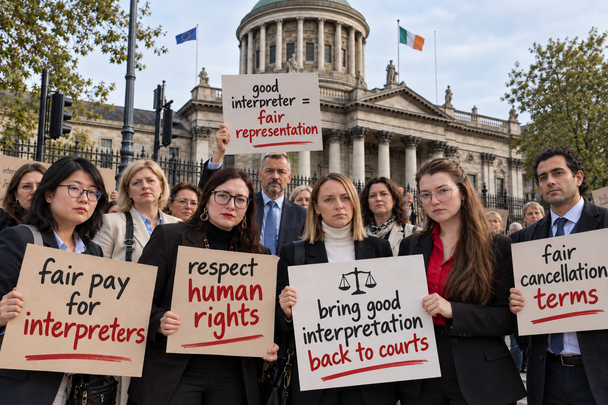
Please set minimum standards: minimum remuneration; payment for travel time and travel expenses; fair cancellation protection; transparent terms before acceptance; contractor accountability and monitoring.
Why is this important?
Public bodies depend on the availability of competent interpreters to deliver essential services effectively. People who cannot adequately understand or communicate in English depend on competent interpreters to access essential services and exercise their rights, including the right to a fair trial. The availability of experienced and suitably qualified interpreters is therefore integral to the effective delivery of justice, not merely an administrative convenience.
In practice, some intermediary interpreting agencies offer contractual terms under which they pay only for time spent actually interpreting, while significant costs and professional time associated with fulfilling the assignment are transferred to the interpreter. These may include several hours of return travel, vehicle and fuel costs, parking and tolls, as well as the loss of other work when a substantial period has been reserved for an assignment that is subsequently cancelled at short notice.
By way of illustration, an interpreter may be offered an 8-hour assignment with a minimum guaranteed duration of one hour and a minimum total payment of €22. The same terms may provide for a cancellation payment of only €11 if the assignment is cancelled within one hour of the scheduled start.
In effect, the interpreter may have to reserve an entire working day and, if the assignment is cancelled within one hour of the scheduled start, receive only €11. Where the assignment finishes early or is cancelled at short notice, replacing the lost work is highly unlikely, as interpreting assignments are commonly arranged in advance.
Where contractual conditions discourage experienced professionals from accepting publicly funded assignments, the consequences can affect service quality, continuity and efficiency, and ultimately the value obtained from public expenditure. If experienced interpreters increasingly decline assignments, public bodies may face a smaller pool of available qualified interpreters and greater difficulty securing appropriate interpreting services when they are needed.
Apparent savings on interpreting costs can create wider costs for public services through delays, adjournments, additional administrative work and urgent replacement arrangements. Poor-quality interpreting can prolong proceedings or, in serious cases, undermine them altogether. In 2021, the Court of Appeal quashed convictions in an Irish criminal case after finding that serious interpretation errors had rendered the trial unfair.
Apparent savings on interpreting costs can create wider costs for public services through delays, adjournments, additional administrative work and urgent replacement arrangements. Poor-quality interpreting can prolong proceedings or, in serious cases, undermine them altogether. In 2021, the Court of Appeal quashed convictions in an Irish criminal case after finding that serious interpretation errors had rendered the trial unfair.
The lowest immediate cost of an interpreter does not necessarily deliver the best value for public money.
Full text of the petition may be found here.
Full text of the petition may be found here.