500 signatures reached
To: Darragh O'Brien (The minister of transport). Emer Higgins (The minister for digitalisation). Anne Graham (CEO of NTA). The Director of Government Communications
Public Info, Public Access - Stop providing public info exclusively on private social networks
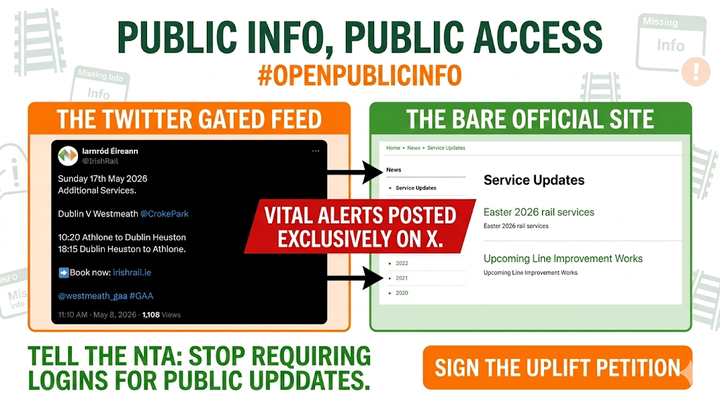
We call on you to mandate that all live public service updates be published on official state-owned domains as the primary source, ending the practice of gating essential information behind private social media platforms. We demand new legislation to ensure platform-neutral communication, prioritizing accessible, account-free digital channels for all urgent public information.
Why is this important?
How this affects you:
Public transport and government services are public goods. But right now, vital updates—like train cancellations, road closures, and emergency alerts—are often shared on private social media platforms (X/twitter) long before they reach official websites or apps.
This means:
- You are forced to use private platforms and accept their tracking just to see public alerts.
- Information is 'Gated' behind logins, its shown along with content influenced big tech algorithms, and there are advertisements. Even though X may allow you to open tweet links without login (for now), you cannot follow an account and see all their updates without a login.
- If you don't use X (Twitter), you're left behind. I believe that if the taxpayer pays for the information, the taxpayer should be able to see it on a public, account-free, state-owned website. No 'followers' required. No logins necessary. Just the facts, when you need them.
Why This Matters
1. Digital Fairness & Inclusion
Public information is paid for by the taxpayer and should be accessible to everyone, not just those with a social media account. People who choose to avoid certain platforms or those who struggle with tech are being left behind. Access to state information should be a baseline right.
2. The Danger of "Gated" Information
When a government agency posts an update only to a private site, they are "gating" public info. This forces you to navigate private algorithms and tracking cookies just to see a train delay or a weather warning. In an era where we are worried about data privacy and the power of Big Tech, our own government shouldn't be handing them a monopoly on our attention.
3. Safety and Sovereignty
Relying on a single private company for emergency and infrastructure updates is a massive risk. If a platform goes down or changes its rules, the Irish public loses its connection to vital services.
Why You Should Join This Campaign
Why You Should Join This Campaign
- For the Commuter: To ensure the app your taxes pay for actually tells you when the train is late.
- For the Privacy-Conscious: To stop being tracked by Big Tech just to access state services.
- For the Vulnerable: To ensure our parents and grandparents aren't excluded from vital updates because they don't have an X account.
- For the Future: To demand that the Irish government lives up to its "Digital Inclusion" promises and keeps public info in public hands.
FAQ
"I use X (Twitter) and it’s convenient. Why change it?" We aren't asking them to stop posting to X: we’re asking them to stop posting exclusively to X. You can keep using your preferred feed, but vital info shouldn't be "gated." Everyone, including the elderly, the privacy-conscious, and those without accounts, deserves the same real-time updates on a public, state-owned platform.
"Does this create extra work for staff to manage two feeds?" Actually, it fixes a broken workflow. Right now, staff are often "double-jobbing" or prioritising social media manually. We are advocating for a "Source First" approach: one update to the official system that automatically syncs to the website, the app, and social media simultaneously. It’s about better automation, not more manual labor.
"Is this just about train delays?" Trains are the most visible example, but this is about a standard for all public bodies - from the Gardaí and local councils to the HSE. Publicly funded information is a public good; it belongs on public infrastructure first.